Why do we die?
As soon as you're born, you're old enough to die...

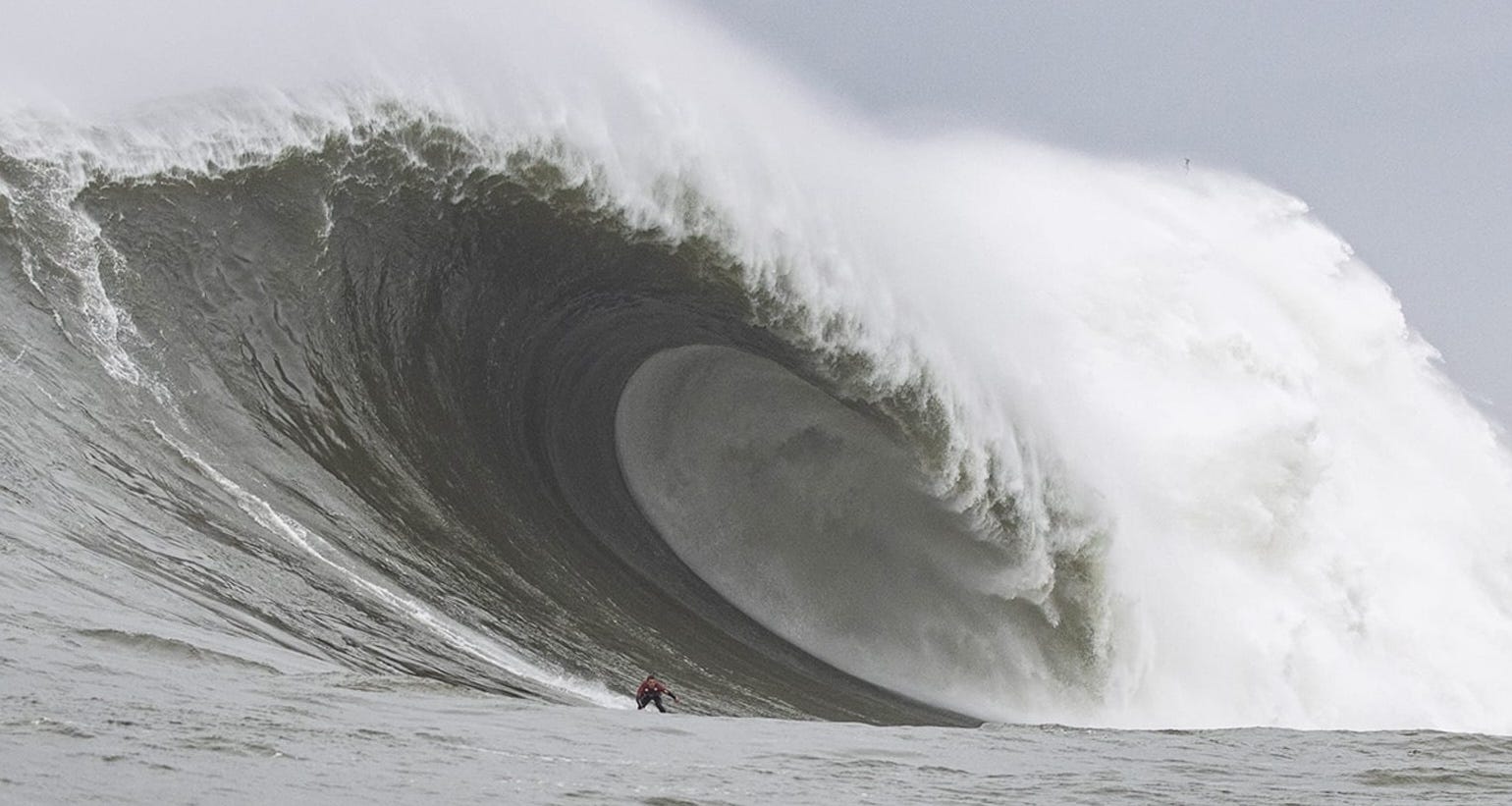
The photo is of surfer Alo Slebir, finishing a ride on a 108ft wave at “Maverick’s” (on 12.28.2024, near San Francisco CA )…
The subtitle is my translation of a German proverb…
Let’s begin by noting that religions (except for Buddhism) are structured around “salvation from death;” so religion makes death a central fact about being human; in this it accurately reflects the centrality to human experience of knowing that I’m going to die
While all living things die, only humans know from early in life that death is inevitable
Contrary to this long history, however, death is not a threat or a curse: it’s a condition of being a living thing
For “living things” are processes: of cell-reproduction, protein formation, and mutation
Darwin correctly intuited that reproduction entailed frequent mutation, which in turn allowed species to adapt to living conditions, food availablity, etc.
But when Darwin published his explanation of this discovery in The Origin of Species [1859], he knew nothing of genes
For while Darwin was completinghis writing, Gregor Mendel [1822-1884] was cataloging the characteristics of cross-breeding pea plants [Pisum sativum], while living as a friar before becoming abbot of the Augustinian abbey of St. Thomas in Brno Czechia
Darwin found himself unable to form a theory of inheritance: how the traits of one generation are passed on to the next
Mendel discovered there are heredity-units (which he called “factors;” they were named “genes” only a generation later) that are inherited in patterns related to what he called their “dominant” and “recessive” character
Mendel published his studies in 1866, but they were misunderstood and ignored; in 1900 his work was re-discovered and soon combined with Darwinian evolution to creae modern genetics
So now we know that traits in parental genes are passed on to their offspring by means of genetically & that mutations occur
Thus genes age as well as mutating: genetic transmission is a process and so is life itself
All processes acquire defects in the course of performing; that is, in the course of their “lives”
These defects accumulate—sometimes magnifying one another—until the process becomes unable to function
So: death comes when the processes that we ourselves are can no longer function
This is true, as well, of the individual organic processes that sustain us, such as vital organs
It follows—as the proverb has it—that death is a condition for being a living thing…
This bleak but accurate formulation seems to require closing with a joke:
Time flies like an arrow
Fruit flies like a banana!
There is no "soul." (I'm writing about this soon...
“What Darwin was too polite to say, my friends, is that we came to rule the earth not because we were the smartest, or even the meanest, but because we have always been the craziest, most murderous motherfuckers in the jungle.”
― Stephen King, Cell 2006
Perhaps we were driven mad by our awareness of our own demise. Like the song says “When you got nothin’, you got nothin’ to lose.”