Why comedy is about "death"
Comfort may be desirable, but it's not funny...


“One day, son, all this land will be yours to sell to a developer.”
My subtitle is a variant of Charles Schulz’ reply a question about “Why he made Charlie Brown always a loser:” “Success may be desirable,” said Schulz, “but it’s not funny!”
So why is “losing,” in all its manifold forms, funny?
It’s because treating the most threatening or painful features of human life as comic allows us to feel a kind of success at diminishing the fear we feel in anticipation of such things
And the feature of life—including human life—we most fear is death
The Robert Mankoff cartoon below is a great example…
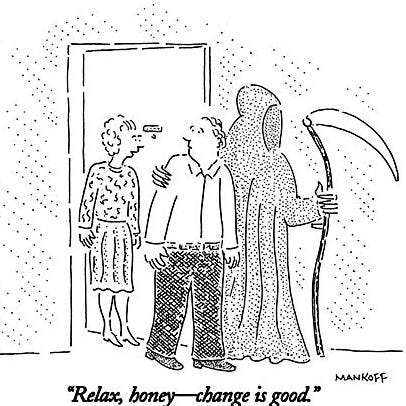
… for it takes a conventional form of advice & exaggerates it’s ultimate implication
The cartoon with which I open similarly exploits a conventional scene of passing to the next generation the assets we’ve devoted our lives to acquiring & highlights the ultimate failure of all our plans
Death, that is, cannot fail to destroy all our efforts at controlling things while we are alive
Comedy is, thus, always about failure, and a certain way death proves we must eventually fail
This is also why personal failure is also always comic: the earliest form of performance comedy showed one failing to keep one’s feet—e.g., suffering a “pratfall”—or otherwise failing to perform everyday actions
Think of how consistently we are all inclined to laugh when someone fails, even a small child in the process of learning to maintain balance, to stand, or to walk
For a different kind of example, I recommend watching Jean Jacques Annaud’s film Quest for Fire [1981]; it was made as a serious attempt to picture human life some 40,000 years ago, but it fails at that…
What it succeeds in doing is to exhibit not only telling the first joke, but also revealing the importance of laughter in the face of death
This ultimate success doesn’t appear, however, until the final scene; as a bonus you’ll get to watch one of the great comic performances achieved on film, by Ron Bergman, who’s sidekick character “Amoukar” has no lines
For final proof:
picture this cartoon I once copied but have lost:
the scene is a giullotine, with a victim already kneeling, his head locked below the executioner’s knife; a woman stands before the victim holding two bags…
…She says, “paper or plastic.”