What is the "meaning of life?"
A history and a warning...

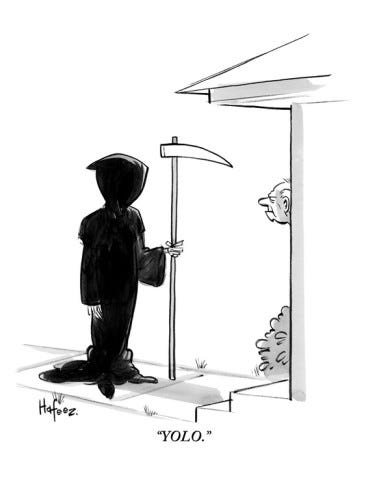
The cartoon gets it right: “You only live once.”
The question is: why has that intuitive truth—as natural to our conscious life as the certainty of death—seemed always to be a challenge?
That is, why do humans seem universally to want to imagine more life?
The answer is desire: we want to remain part of the world; we don’t want to give up our lives
This desire has driven people to imagine a great many ways of somehow hanging on to continued life
The inference is: only if I can continue to be can my life have meaning; or, conversely, my life has no meaning if it is just over with death
But this conclusion is wrong: it’s rather the case that life is meaningful only if each life ends with death
Here’s some of the proof for that claim: (1) there can be meaning only because of consciousness (or, more exactly, self-consciousness); (2) meaning arises from consciousness because I assign meaning (or value) to things; (3) assigning meaning equals choosing or ranking the importance of things
Conscious life, then, consists of selecting, in the course of my life, from among the many things and events that occur around and to me
These things include family members, social relationships, the surrounding world (aka “the environment”), and the large set of things that are supposed to have meaning
The last claim is crucial: from infancy—including the acquisition of my first language—I am taught what is important; we each of us acquire with our language a large array of meanings
Many of these are aimed at teaching me my place in the world, the community, the family, and so on
Over the course of most of human history for example, so far as we can read about or reconstruct it, men have been taught to believe dying for your country (or “your people,” or “your leaders”) gives meaning to one’s life
We all know that what is actually at most conferred by dying in combat is a memorial plaque or monument of some sort; so why has this claim persisted?
In part the claim serves a social purpose: the expansion of territory through warfare; another part is the subtle substitution of political values for the personal act of evaluating; joining forces with others relieves me of the burden of making my own choices
For the threatening fact is that we are each of us responsible for the forms (or meanings) of our lives, even though genetic inheritance and birth-circumstances are fixed
My life has meaning, in other words, owing to my choosing to participate (or not) in the roles and patterns assigned to people like me
The experience of choosing is masked by the many cues and commands that surround us…
Consider the word “no”
The philosopher Jean-Paul Sartre [1905-1980] once described the child’s discovery of “no” as the origin of self-consciousness: I become actively myself when I learn to refuse to go along or to get along
This points to the contrast between self-awareness and social membership: like me, you can probably recall many times and ways of being told to “get along”
Greta Thunberg [2003- ], to take a contemporary example, in the face of worldwide public denial of “climate change,” refused to attend school one day per week, instead carrying a sign before the Swedish Senate building announcing “SCHOOL STRIKE FOR CLIMATE”
Those who take a stand single themselves out and so become examples of my point above that individual responsibility is threatening
If the single opponent is joined by others they may become “heroes,” as has Thunberg; but even if not, their willingness to face up to the threat of being singled out reminds us of the everyday task of choosing meaning for my life
My own life has now lasted nearly 90yrs and the importance of this work has never seemed more alive—or more meaningful—to me…