What is "government?"
"Of the people..."

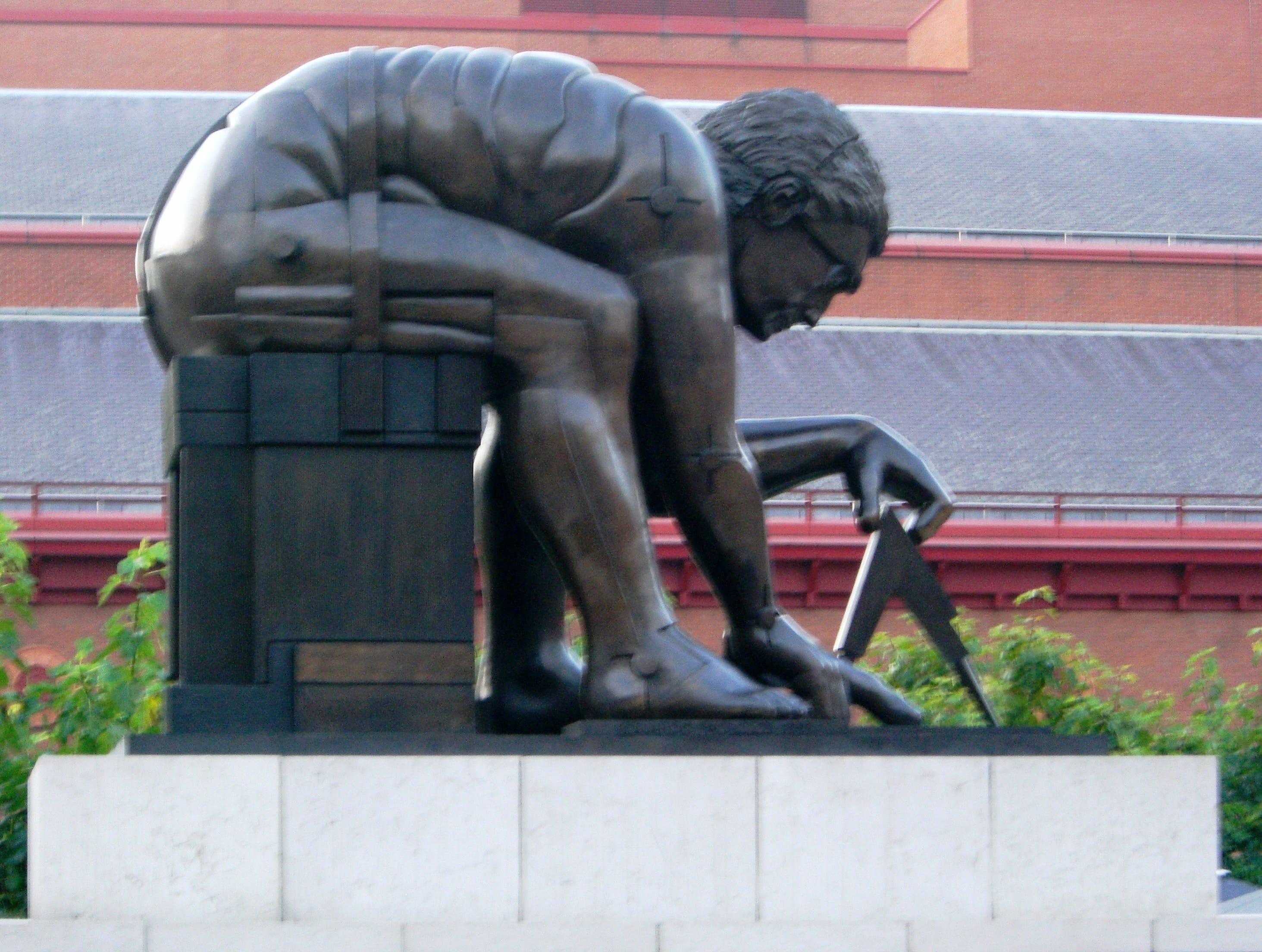
(The photo above is of a sculpture—outside the public library in London—of Wm. Blake’s [1757-1827] imagining Isaac Newton [1643-1727] as having “turned creation into a geometry problem”)
It’s certain that, by the 19th c., Newton’s “laws” of physics & the general development of mathematics into the primary model & tool for science had affected the organization of Western society
Lincoln, in his address at Gettysburg [19 Nov 1863], following the Union defeat of the Confederate invasion of Pennsylvania, said that the Union success had saved the U.S. principle of “government of the people, by the people, and for the people”…
The American founders’ articulation of an entirely new form of government—formed by representing the people governed—however, is unique in the history of human societies
The Athenian Greeks in the 5th c. BCE invented democracy, but it does not mean “government by the people”
Demos, in Greek, means something closer to what we would call a “district” or even a “country” (in the sense of a region all have in common)
Athens, like many ancient cities, was sectioned into districts—demes—in which many of the residents of each district were related to one another; representatives were elected [Athenians invented elections too] from the deme to serve in city government
Since humans require society—a group large enough to provide for the long gestation & growth period of humans—they require government
Government is the structure of rules—morals, laws, regulations, etc.—that ensure the agreeable (which is to say: “fair”) assignment & division of tasks, property, protection, and so on, as well as the collection of money—that is taxes—necessary to pay people doing the work to apply & enforce the society’s rules
(Of course, what is fair is always debatable; to eliminate endless debate humans settled on the rule of the majority)
What government provides, therefore, is a stable order for the life and work of the people it serves
U.S. government is uniquely stable, even among the many modern democracies; one of the things this stability has provided is an environment for innovation and “development” (which ranges from construction to invention & manufacture)
One of the still celebrated achievements of this stable government its the mobilization of all U.S. manufacturing, creating in one year—1942—a society that built weapons and armies sufficient to fight two wars simultaneously in two different hemispheres of the earth, and to win them both in three more years!
Here’s my point: this historic event in my youth—I’m 89 & grew up during WWII—is a consequence of a superior government
“Superior” here means: more stable—because formed & supported by a majority of its people—and so providing a more predictable or reliable society and life for all the imaginable achievements of the best human condition
But even American government has not always served the people; electing officers for governing positions only rarely results in a president interested in what best provides a good life for all Americans
The extraordinary American action during WWII would not have been achieved, for example, were it not for the leadership of Franklin Roosevelt, who was the rare president interested primarily in what was best for the people…
To paraphrase Lincoln, we are now a government of the rich, by the rich and for the rich. And worst yet, we voted for this (despite our denials).