What is "climate change?"
And what does it have to do with philosophy?

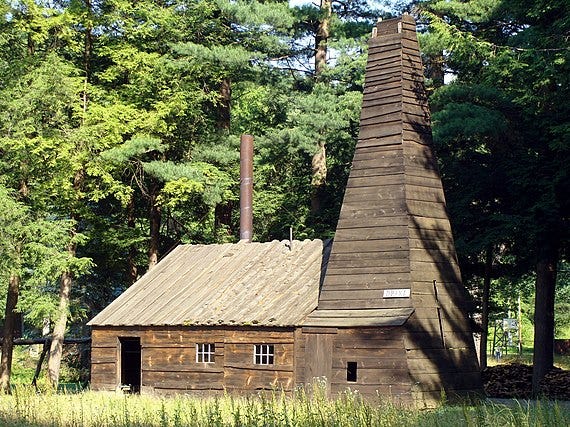
The photo above is the reconstruction of the “Drake well,” the first “oil well” that successfully drilled into the rock of western Pennsylvania to extract petroleum in 1859
“Petroleum” [from the Latin for “rock oil”] is a compound of hydrocarbons produced by compression (over millenia) of plant life and seawater buried by geologic processes; this “pressure burial” is called “fossilization”
Earth’s petroleum-laden rock occurs where there were ancient oceans
Some 26million years ago, for example, the Africa & Arabia tectonic plates rifted apart to form the Red Sea, burying seawater-laden materials that account for the enormous petroleum deposits under the Arabian peninsula
When Edwin Drake adapted a steam-powered water-drill and penetrated bedrock to release the “oil” contained in it, he initiated a process that now affects the surface of the entire planet
That process is the release of carbon dioxide by burning “fossil fuel”
Carbon dioxide—CO₂—accumulates in earth’s atmosphere and focuses sunlight: this accumulation & focus is what we are now experiencing as “climate change;” it’s the result of some 150yrs of restoring ancient CO₂ to the atmosphere
There are other sources of CO₂—volcanoes, for example—but their total annual emissions are dwarfed by the CO₂ released through humans burning fuels in the billions of machines—including the cities—we’ve built for the purpose since the 19th century
“Climate change” is therefore almost entirely produced by human activity…
This human project raises a philosophical question: what is our responsibility (where “responsibility” means “answerable for…”)
Human activity is answerable for the nearly 200% increase in atmospheric CO₂ since the 1860s, but the resulting changes in earth’s climate mainly affect human life on earth; climate change affects the earth itself almost not at all, except for the oceans
So its mainly the continued survival of humans on the earth that is at stake as the climate changes we have created unfold; our lives depend not only upon earth’s surface temperature, but also upon the health of the oceans
Expert opinion—the scientific form of “wisdom”—has for decades shown that earth’s atmosphere can recover to its state two centuries ago only by reducing CO₂ emissions
Yet only about one-third of humans have caused climate change: these are the citizens of the “developed world:” the world made by burning fossil fuels
We are already reminded daily of the fact that the whole world—and all its peoples—is affected by the work of the “developed” part: the millions of humans in the regions and on the coastlines being made uninhabitable by climate change have begun to migrate
So “migration” is also an aspect of our responsibility for climate change; this accounts for its current exploitation as a political issue: if we are answerable for any portion of the changes underway in the world, we are answerable for all of them
Thus one of the actions we have to take in the face of these responsibilities is to make room for the people who must move to live
One of the typically human reactions in the face of change is to deny it or fight against it, but we know this never works for long…