What is a family?
A brief history...

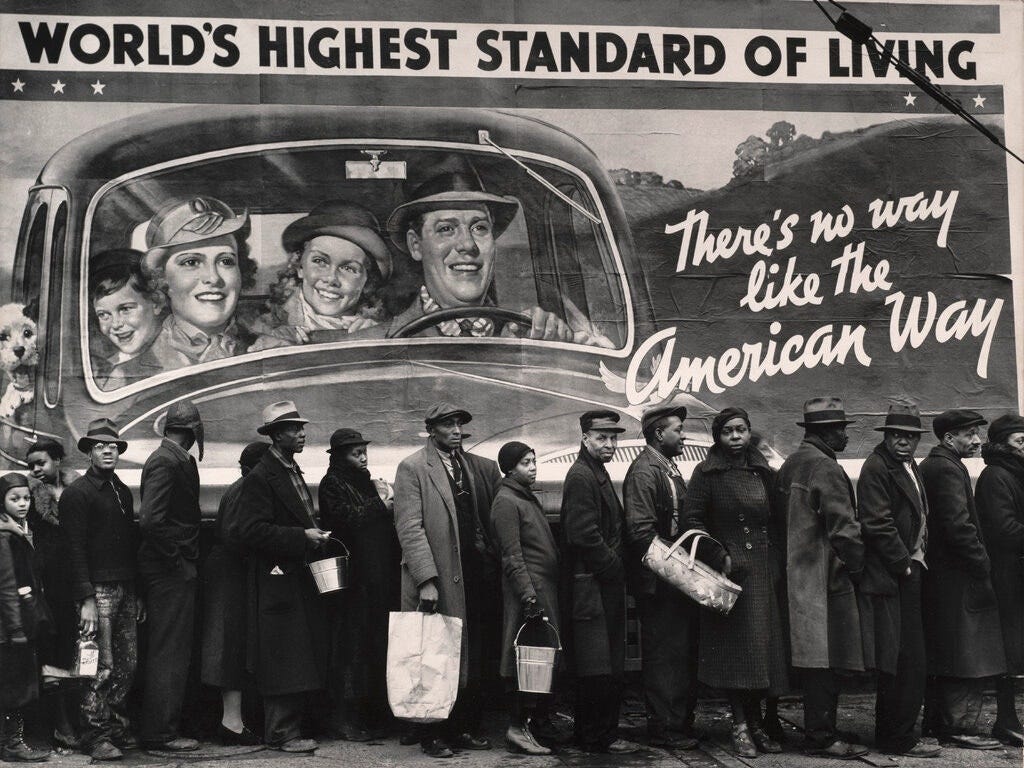
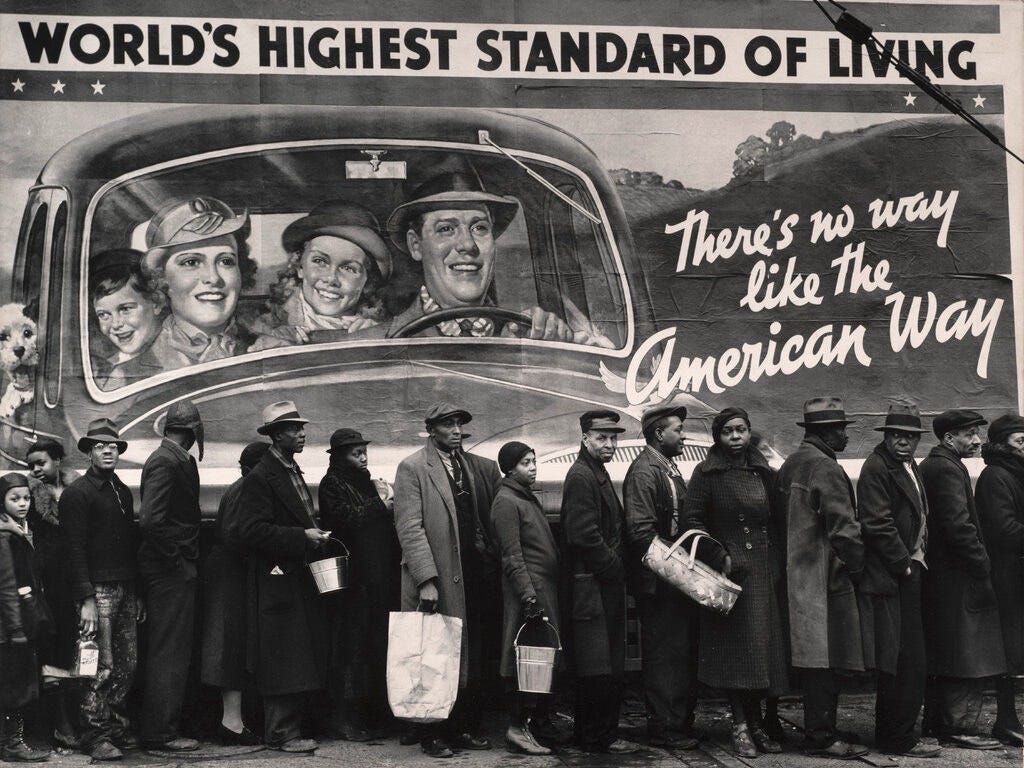
The year of this photo is probably 1938. The irony is painful. Very likely your eye was first drawn to slogan advertising “the American Way.” Next, if you’re like me, you registered the occupants of the car: male driver, girl, woman passenger, boy, dog
Actually, most will have first read the people in the car as: dad, daughter, mom, son… In other words, a “family”
Why? How is it that we take for granted that a “family” consists of two parents and their children? And how long has this been so?
The answer to the second question is, not long: little more than two centuries
You’ll protest: “What? The family has existed since we became humans!” You’d be wrong. The notion of “family” as two parents and their offspring is a product of the industrial revolution
British economic historian Arnold Toynbee [1852-1883] coined the phrase “Industrial Revolution” in a lecture series published after his death; he said it was characterized by “substituting competition for the medieval regulation… of the distribution of wealth”
Note the term “distribution:” it’s what we experience as “inequity,” about which more in a moment
The other feature of the “revolution” that began in England and spread throughout most of the world from the 17th c. is “manufacturing”
“Manufacture” literally means “made by hand,” but it’s never actually meant that, at least since somewhere around 1760: that’s when the process of mechanizing production began in England
Manufacturing—substituting mechanical power for human—continues to this day: over the past two and a half centuries, in addition to goods, it has produced cities, industrial plants, mines, railroads, commercial shipping, insurance, and capitalism
It also effectively eliminated farming as an occupation, at least for all the peoples living in what we came to call “developed countries:” at the turn of the 20th c. farming was still the livelihood for more than 20% of Americans; by the beginning of the 1920s it was down to 5%. Since WWII even “industrial farming” employs fewer than 1% of Americans. The ratio is similar for Europe and other industrialized countries
The factor that’s relevant here is that the work of farming—on which both the landowner and the farmer depend—is distributed amongst all who live on the land
Industrial work—by contrast—is confined to a special location and requires a work force that travels to the location daily
Early on men, women, and children constituted this work force; well into the 20th c. most people opposed legislation limiting the hours of work for children; legislation establishing the 8-hour day and the 5-day work week took effect in 1939
By the middle of the 19th c.—just before the U.S. Civil War that is—American life began to resemble that of Britain (the pioneering industrial country): men went to “work” while women remained at home to care for children
It was in this way that the “nuclear family” was created: a once multi-generational form of life—farming in which all took part in the work—became “modern”
Did I mention that wages were also created by the industrial revolution?
That is, men became the “wage earners” (also ironically once known as “breadwinners” even though producing grain had been eliminated from most people’s lives) while women and children became “dependents”
“Family” has, of course, become a popular metaphor, meant to suggest that we are all members of some common community
But we are not, as the photo above illustrates: industrialization not only shrank the “family” to husband/wife/children, it divided the working population into ranks, based—especially in the U.S.—on skin-color
This is a phenomenon we still confront, and suffer from, but that’s another question…
I’ve read that the understanding amongst the landed gentry and monarchy was “waste people,” (aka; debtors, paupers, the Irish) could be shipped off to the New World as indentured or slave labor to fuel the first blushes of modern capitalism and its reliance on uncompensated work to generate profits for “investors”.
Waste people, as they were known in Britain, eventually became known as “white trash” in the America, dwelling, as they did, on lands of such poor quality it was considered waste land, or trash land. The tag of being ‘white’ came in when the owner class created a bulwark against the rise of this large, uneducated working class by putting Black and Native slaves between them and fair compensation for their labor. A moniker in born.
Generations later the descendants of this strata of immigrants lashed out at their perceived oppressors— elites in Washington, the educated, Blacks, Natives, etc., by electing a mobster who hates his ‘betters’ just as they do.
History is mostly about assholes and their choices. But we pay little heed to the fact and thus repeat, repeat, repeat.