What does "conservative" mean?
The role of feelings in history...

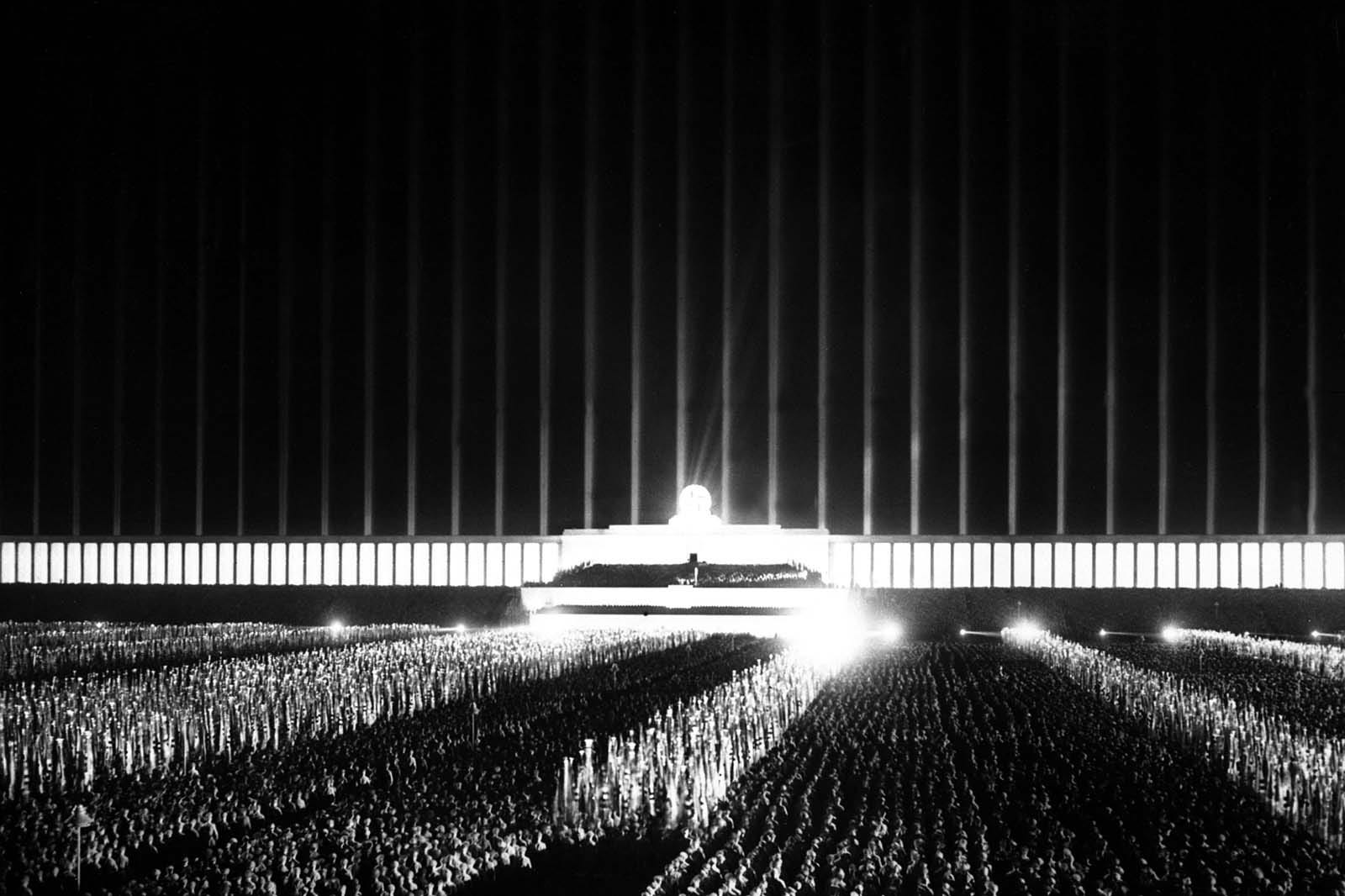
The photo above is of the “Lichtdom”—”Cathedral of Light”—created by using hundreds of searchlights spaced in a circle large enough to enclose the 700,000 people who attended the first Nazi Nürnberg [Nuremberg] Rally in 1934
The rally, planned by Albert Speer, was held on the Zeppelinfeld; it was filmed by Leni Riefenstahl [Triumph of the Will, 1935] to dramatize Hitler as the Führer [Leader] of the whole German people
It worked: Germany became a propaganda state; American news correspondent William Shirer attended that first rally, then wrote: “I am beginning to comprehend…the reasons for Hitler's astounding success. Borrowing a chapter from the Catholic church, he is restoring pageantry and color and mysticism to the drab lives of 20th Century Germans.”
(In 1780 the Catholic church created a Congregatio de Propaganda Fide—“Committee for Propagation of the Faith”—and so contributed a term to the language that would come to dominate the 20th century)
Shirer speaks of German lives as “drab” because the consequences of economic depression (after WWI and especially of 1929-1933) were even more pronounced in Western Europe than they were in the U.S.
“Propaganda” means “to propagate:” that is, to multiply, in this political sense, the circle of people willing to believe the “message” being delivered
Hiter’s central lie was that Jews were the cause of not only the economic depression but of all social problems; his obsessive hatred was used to martial popular support, that is, to propagate the lie that some people were responsible for the historic changes in the early 20th century
We know that “feelings” do not exist in the world [cf. Philosophy Now: 26 Apr & 25 Jul 2021] but only in our brains: each of us assigns feelings to experiences; the public aim of propaganda is to offer the audience a object for their feelings; since all of us already have feelings—of anger, sadness, and fear—most of us are eager to have a focus for these feelings
Hitler offered “the Jews” as an object on which to focus the feelings of his listeners…
The term “conservative” entered the language with the writings of Edmund Burke [1729-1797] in which he opposed the French Revolution and its destruction of the French monarchy: Burke was against changing the political order of society
To be against change (of some beliefs or practices) is central then to being conservative; William Buckley [1925-2008], the most prominent 20th c. American political conservative, founded the National Review; in its initial editorial he wrote: “The conservative “stands athwart history, yelling Stop, at a time when no one is inclined to do so…”
Hitler, too, wanted to “stop history;” Hitler’s speeches contained repeated shouts of “Einen Volk, einen Reich, einen Führer” [“One people, one nation, one leader”]—that is: Hitler’s appeal looked back to the German monarchy which ended during WWI (along with the dozens of other monarchies in Europe and elsewhere); a “monarchy,” is literally government by “one ruler”
But “history” cannot be stopped, any more than can time itself
So the actual aim of being conservative is to reverse some changes that have already happened in society or culture
This can be done, at least temporarily, by doing violence to the people and events that constitute any society
In the 12 years that Nazi Germany existed, thousands participated in vilifying, attacking, imprisoning, torturing, and killing millions of people blamed for bringing about cultural changes
Yet for all that violence and death, as for so much before and since, history—that is, social and cultural change—did not cease; nor will it ever…
🎶““Nazi schmatzi.” says Vernor Von Braun”🎶