What are "politics?"
The history we've created...

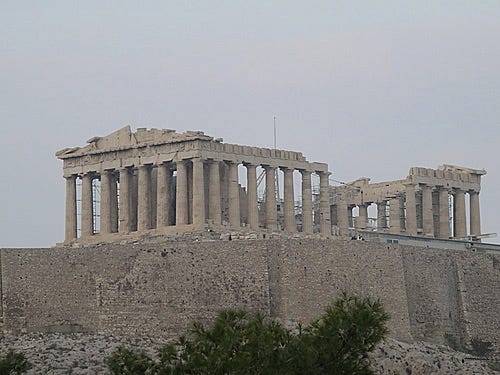
The photo depicts what remains of the acropolis in Athens Greece; the word means “city heights” [acro = “heights” in Greek; polis = “city” or “state”]
It was the philosopher Aristotle [384 - 322BCE] who defined humans as zoon logon politikoon = “beings who speak & live in cities”
Aristotle’s emphasis upon the centrality of language to our being “political animals” makes the point that our need to live together to be human depends upon our talking & understanding one another within the structure we build to make for human life
So the first point is that “politics” depends upon language & upon our willingness to talk about how are to live together; that this process is never complete is the second point…
That is: there is no “final” or “perfect” form of politics; we all keep making & renewing it by the fact of our living together
So “politics” is a continuous process of creating a human form of life; the needs, dimensions, & quality of that life must be renewed constantly; which is to say, must be re-negotiated all the time
The reasons “city life” is essentially human arise from the necessity of our growing food, fostering children, managing work, and building shelter; but central to all these is our need to talk to one another
You have experienced a form of this if you’ve ever visited or lived among people whose language you didn’t speak; the urge to find someone to talk to is intense—even if you want only to say how you’re feeling or ask questions…
If you listen to the conversations going on around you—or even pay close attention to what you talk about with others—you’ll have noticed that (once the complaints & criticisms are over) we mostly talk about getting along…
This concern about how we get along is the elementary & essential expression of politics
But, being human, we also need to impose order in the form of political arrangement or management: we need rules, laws, and ways of life to govern our daily & historical shared existence
Thus governance is central to politics
If you know any history, you know that there are very few forms of governance: political order is achieved & maintained either by centralized command or by shared authority
The “centralized” form of life—typically as monarchy —has dominated human history; arche in Greek means “rule,” so “monarchy” = one ruler
(It’s not clear why this form of governance has dominated history; perhaps it arises from the human desire to rank order people, or else from the need of some people to dominate others)
In any case, a politics of shared governance has been rare; the first serious effort to imagine & plan for shared governance took place in the revolutionary project of mostly landowners in the still-British-colonies created by the European invasion of North America…
These men—the architects of the Constitution of the United States—met to formulate lasting rules for shared governance…
And they succeeded! They did so in the sense that they proposed a framework for organizing shared power & for the regular transfer of that power…
It’s this last point that was history-making: under the Constitution, the power to govern must be given over to others after it has been exercised for a few years…
In other words, once you have been given the power to govern—via another U.S. innovation: voting—you must be willing to pass on that power
A blunt way to put this is: the transfer of power requires losers
The U.S. Constitution was designed to make it acceptable to us all that those who wish to govern must also be willing periodically to allow others to govern
Of course, the 18th c. picture of a well-governed political life had all the limitations we’ve argued & fought over ever since: those who deserve to govern were at first just landowners, then white men, then just men, and so on…
The point is that the Constitution—the outline for shared governance—has been & still is undergoing change; it was designed to allow for change
But—and finally—for the most part people don’t like change; “change” ultimately = death; and even short of that, it means different ways of life emerge
Remember that there is no final or permanent form of politics; that’s also true of the rules of life that we also call “morality” and “ethics;” adults often need to believe the “values”—another word for “rules of life”—that informed their own lives are fixed or permanent
They are not: all these terms—values, morals, ethics—are words for customs; that is, the rules of life for any period are just those that have been adopted, practiced, taught, and more or less observed
Societies adopt terms like “tradition,” as well as “value” and others to suggest these customary practices are stable and deserve to be continued
But the young aren’t always convinced; thus new rules emerge nearly every generation and the earlier ones fade—one more reason the old so often resent change…
This also “politics:” existing standards or rules must give way to those that are to replace them, just as those who have been in political office must hand over the power of governance to those others who have now been elected to take office…
A footnote: democracy—demokratia—is the term the ancient Athenian Greeks gave to this system of “shared governance;” it means government (krate) by “the people” (demos); yet they were concerned even then that some who wished to cling to power would refuse to hand over governance by appealing to the popular resistance to change…