Truth: Part V
In the beginning...

Whenever I encounter people who assert the “literal truth” of biblical texts I like to ask in what languages they’ve read those texts; I imagine few even know how many languages are the sources for the translations they (perhaps) read, or at least hear about
For the history of christianity the most important of those languages was koine [meaning: “common”] Greek; it was the language in which Paul [03-66CE] wrote, because it had become a commonly spoken language in the various cultures all around the Mediterranean
So even for christianity, as for so much else about the history of western thought and politics, Greek is central
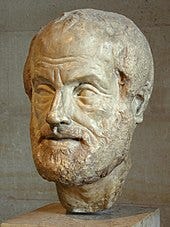
And in several ways Aristotle is central to what we still experience from our Greek origins; when I say “Greek,” of course, I refer to the culture of Athens: the dominant city of the Hellenic peninsula for some two centuries, beginning around 500BCE
Aristotle himself, as you can see, lived during the 4th c. BCE, as Athenian “democracy”—the first example of a representative government—was coming to what would be its end
As I’ve suggested, there’s an almost infinite amount to say about Aristotle’s thought, but here I’m focusing on his account of “logic”
Logic is an extension of logos (phonetically: “LOWG-OSS”), which is Greek for “language;” I began with the remarks on christianity because what we read as the Gospel of John opens with: “In the beginning was logos…”
In translation the sentence reads: “In the beginning was the word…”
In other words, this early christian writer held the divine principle to be language
One thing this suggests is that the divine must be both orderly—in the sense that it has or conveys meaning—and understandable
The ancient Greeks prized their search for—and analysis of—order in matters of thought and speech; they named the process of inferring conclusions from assumptions logic
Logic can be a dense topic, so here’s a joke to begin to illustrate inference:
Holmes and Watson are camping, preparing for sleep:
Holmes: “What do you see Watson?”
Watson: “I see millions of stars. What do you infer from that Holmes?”
Holmes: “Watson, you fool! Someone has stolen our tent!”
The INFERENCE Holmes makes is: IF [Watson can see stars], THEN [there is no tent above them]; this “if…then…” pattern—called a “conditional”—is the basic form of verbal logic
The point of invoking it is that, given one or more assumptions, a conclusion can be shown to follow from them; using inferential—or conditional—logic we can prove a conclusion
Logical truth in this sense is a function of inferring a conclusion from assumptions (also called “premises”)
But—and here’s the important point—while a conclusion can be shown to follow from the assumed premises, the quality of the conclusion depends upon the assumptions
In other words: conclusions can be proved, but they are true only if the assumptions are; there is no proof for assumptions; of course, they can be conclusions as well, but only based upon earlier assumptions
Remember the emphasis upon “stories” in my accounts of historical and scientific truth? Stories—pictures of experience we draw with language—are indispensable as beginnings for thought
We always have to begin somewhere; we inherit the stories with which we account for experience by learning the languages we speak
Language is a repository for the ways we have understood the world and our experience; in this way it shapes in advance our understanding
Every so often a thinker—usually but not always a philosopher—creates a story that revises our experience; Aristotle was such a thinker—as was his teacher Plato—so in the reflections to come we’ll have lots of occasions to invoke their insights…