Truth: Part IV
The triumph of knowledge...

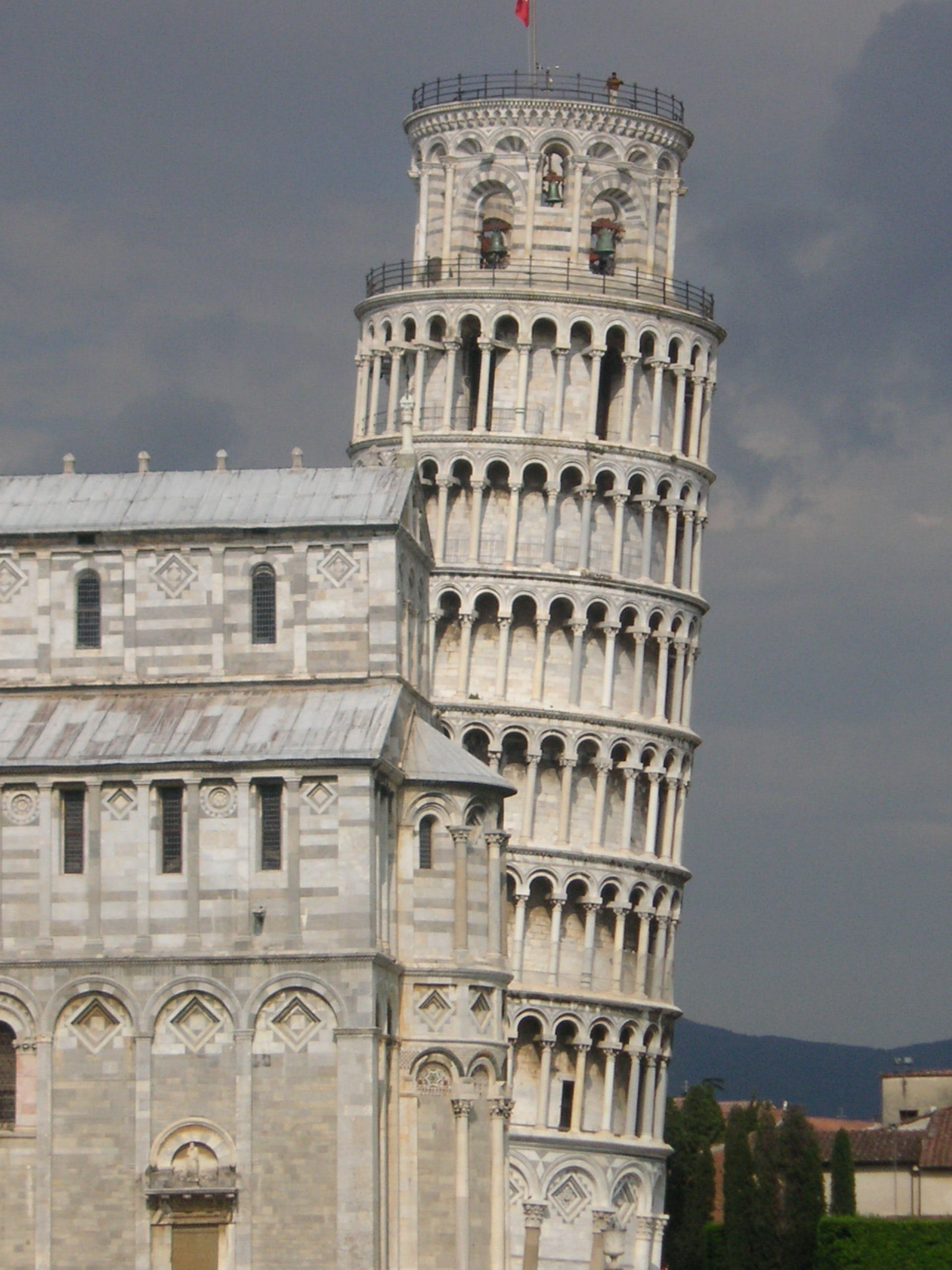
An apocryphal story has it that Galileo demonstrated objects of different weights fall at the same velocity by dropping things from the tower in the piazza of Pisa, where he taught at the university
Even though Galileo didn’t do this, the tower itself is a kind of tribute to the physics of structures: I took this picture from the south side of the duomo to emphasize the 17deg that the tower—technically a “campanile” or bell tower—leans from the vertical, which it has done since shortly after construction in 1372
So what does this have to do with science? The central point is to emphasize both the nearly 400yrs that separate us from the emergence of the “scientific revolution” and the proximity of that time to the present
So we are still very close to the beginning of the “modern project” to subject the world to our way of knowing it, via mathematics, astronomy, physics, biology, and so on
In the chronicle I sketched last time, the idea of a “created world” survived all of the scientific insights into motion at every level, from planets to gases
Then Charles Darwin [1809-1882] graduated Cambridge University and accepted appointment to the office of “naturalist” aboard the HMS Beagle under the command of his friend Robert FitzRoy; the ship left Portsmouth in December 1831; Darwin was 22 years old
The voyage of the Beagle lasted five years; when it once again reached England in 1836 Darwin had already begun the intellectual voyage that would lead to his theory of the “origin of species”
A theory, like an idea, is a way of seeing; in other words, you can’t locate any “facts” until you have a theory; this is the opposite of the conventional view, but the conventional view is wrong: theories make for the development of knowledge
Remember the role of “stories” in the unfolding of historical truth? A theory has a similar role: it proposes a set or pattern of relations that link phenomena (which is a Greek word for “what shows itself”)
Motion, force, weight (or mass), gravitation, and speed—for example—are phenomena that were linked mathematically by Newton’s “Laws”
By the 19th c. Darwin lived in a world shaped for three centuries by the close observations of people we now call “scientists” [though the activity was then still called “natural philosophy:” these were people asking questions of nature]
No one before or since has done better at Darwin’s job as “naturalist” aboard the Beagle; among the phenomena he encountered: seashells in the mountains, oyster shells embedded in rock, hordes of plankton gathered by the net he had towed behind the ship [“Why,” Darwin thought, “were there beautiful creatures in the ocean where no human could see them?”], fossilized bones of enormous extinct mammals and imprints of trees in sandstone at 7000ft above sea level, an erupting volcano in what is now Peru, mussel beds on rock now above high tide…
In September 1835 the Beagle anchored off the Galapagos Islands; when it left a month later Darwin was wondering still why what appeared to be the same species of bird on each island had differently-shaped beaks?
It took Darwin more than two years to work through his almost 2500 pages of diary and notes and conclude that a process he called “natural selection” had shaped animals by adapting them to their environment over generations
And that was the end of “creation.” Species of animals—including humans—were not “designed” but evolved—and sometimes became extinct—to fit the demands of the world in which they lived, ate, reproduced, and died
Darwin was rightly fearful that his theory—destroying as it did millenia of human stories about the “origins of things”—would be met with hostility; he worked writing and revising his Origin of Species [1859] for nearly twenty years until hastily submitting it to the London Royal Society when a young geologist, Alfred Wallace, told Darwin he was about to publish his own theory of evolution
Back in the 16th c., when the Vatican was persecuting Galileo, they were rightly fearful that—already by that time—a new theory could reveal a new truth; almost two centuries after Darwin’s proof that his theory accounted for a vast range of phenomena, people are still willing to rant about whether it’s the truth
We know that it is, so far…