Truth: Part III
A history of "science"...

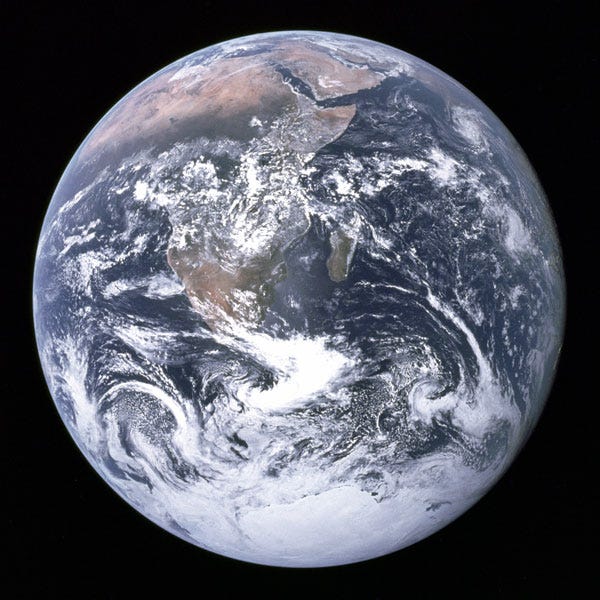
This image of the Earth—29000mi away—taken by the Apollo 17 crew in Dec 1972 became known as the “Blue Marble” photo; the crew themselves felt humans would now see their planet both as a small entity in the expanse of the universe and as the fragile world on which their lives depended
The Apollo 17 astronauts—in other words—expected that this image would change the way we picture of our existence
People used to know much more about the night skies than we do; for one thing, it was dark. Being far out to sea is the only experience I’ve had that I think comes close now to ancient views of the sky
So people were quite aware of the phases of the moon and the apparently random movements of the planets visible to the naked eye. The random” movement was a puzzle because ordinary experience—and the theology based upon it—saw the earth as at the center of the motions of the “heavens”
Ancient humans—at least as we understand their outlook since the development of writing—thought the world created: that is, the realm of ordinary experience was somehow intentionally formed
Thus a great deal of human thought was devoted to how to relate to the world’s creators: worship, sacrifice, cunning, resignation, manipulation, devotion, revenge, and withdrawal were all practiced (and became permanently enshrined in our languages); I’ll return to this point…
The picture of a created world survived even when Mikolai Kopernik [1473-1543]—Latinized as “Nicholas Copernicus”—proposed that the complex geometry of the “Ptolemaic system” (in use since the 1st c. BCE) could be simplified by postulating the sun as the center of the orbits of the planets, including the earth
Almost a century later Galileo [1564-1642], using his improvements on the “telescope” invented in Holland, was able to see moons orbiting Jupiter; but when he published his evidence for the truth of Copernicus’ calculations he was persecuted by the Vatican for the rest of his life
Yet even Galileo did not need to cease to believe the world created: rather the “solar system” could also be seen as evidence that the creator employed more elegant mathematics for the “movements of the heavens”
For example, Johannes Kepler [1571-1630], after years attempting to calculate circular planetary orbits (for the divinely created “heavens” had to move in perfect circles), finally proved that the planets’ movements were mathematical ellipses
If you’ve been reading the dates above closely, you’ve noticed that by the 17th c. it appears that everyone capable in mathematics was busy using it to analyze the world of experience; Kepler’s discovery was enhanced by his proof [called Kepler’s Third Law] that the the square of the orbital “periods” of the planets—what we call a “year” for the Earth—are equal to the cube of their axes
The French philosopher and mathematician Rene Descartes [1596-1650] was central to this explosion of “science” in the 17th c.; Descartes invented analytic geometry and argued that the world could be understood as an entirely mechanical process
Which brings us to Isaac Newton [1643-1727] and his revolutionary work The Mathematical Principles of the Philosophy of Nature [Philosophia Naturalis Principia Mathematica]—known universally as the “Principia,” and pronounced PRIN-KIP-EE-A; Newton, like his contemporaries, accepted that Descartes’ “mechanical universe” had initiated a “scientific revolution”
A note: “science” is Latin for “knowledge;” so the “new philosophy” was a path to a new kind of knowledge about the world
Mathematics has a history even longer than philosophy, yet Newton’s rigorous proof that all observed motion could be described by a set of “laws” for force and attraction (i.e., gravitation) made it the dominant method for analyzing creation it remains to this day
I say “creation” still, for even after Newton’s total “science” of motion it was still possible to believe that the universe—even if an enormous “machine”—was formed and set in motion by a deity…
[This has become a challenging read by now, so I’ll carry on the history in the next installment…]
Going easy on the undergrads. The midterm will be packed with names and dates! Study!!
Thanks John, I find this fascinating.