Truth: Part II
The story of history...

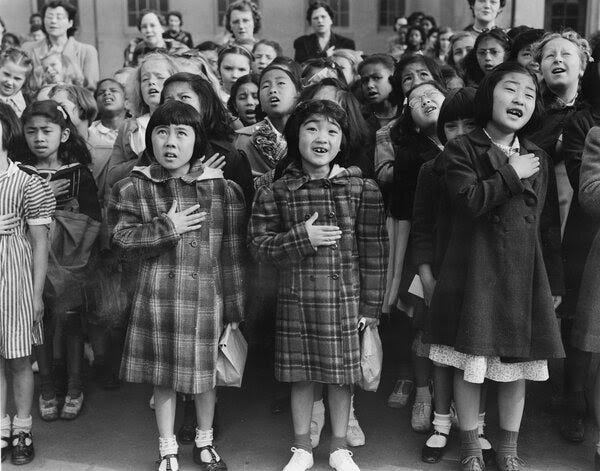
I wrote about the photo above in the entry entitled “Why Wait for Social Justice?” It was taken by Dorothy Sayers in February 1942 of 2nd graders at Weill Elementary School in San Francisco as they say the Pledge of Allegiance before class. I was in the 2nd grade in 1942, down in Los Angeles, and—yes—we did put our hands over our hearts to say the pledge in those days
There were many kids of Japanese descent in my 2nd grade class too; some of them were my friends; they, too, disappeared a month later and I didn’t learn what had happened to them until the winter of 1945
So: how do we learn the truth about history? Just what is “historical truth?”
In part one I claimed that truth is “what can be known.” It’s easier to know what you think personally—even though we normally shy away from pressing for that truth —than it is to know what happened, even recently
But just as for each of us, there are contrasting or competing stories about what happened in the past; so the first step on the path toward historical truth is gathering, comparing, and assessing those stories
This is called historical research, but everything depends upon what I choose as the basis for such research
In the 1930s and after WWII a number of French historians began to study human activity over long periods, using sources such as local records and legal proceedings, instead of focusing on the documents and policies of the government
Think about how much difference there is at any time between my daily life or yours—assuming we’re not government officials—and the proceedings that take place in the capitol; even the state capitol, let alone the national
That focus on daily life offers a distinctive picture of history—which is, after all, the passage of time—such as is depicted in Sayers’ photo of those 2nd graders in 1942
When I learned later in my schooling that imprisoning Americans of Japanese descent was U.S. government policy—Executive Order #9066 signed by Pres. Roosevelt in February 1942—I discovered more of the truth about what happened to my friends
I was in the 6th grade by then and—though I didn’t yet understand it—had made my first encounter with irony: the fact that the phrase “…one nation, indivisible, with liberty and justice for all” is central to the Pledge of Allegiance
But I digress. We were talking about how you get to historical truth. The broad answer comes back to questioning: you have to keep asking what story might lie behind the various details that remain from the past
There are at present many writers—some trained historians—who work to develop accounts of present and recent events: they write new stories about the past
We enter into the truth of the past via the stories we tell and accept
Two things follow from this: one is that it matters who gets to tell the story; the second is that we choose what story to believe
Remember “belief?” I suggested it stops short of knowledge, usually for the sake of protecting myself and others, as dramatized in Anderson’s story
But there’s another feature of belief: it leaves open the possibility of change; I can always change my mind
So the truth about history is that it’s an always-changing story; it’s relative to my time and place, and also to my place in the society and political order in which I live
Right now in the U.S. we’re experiencing once again the disruption created by the development of a new story about who belongs; who deserves to be a member
In another way, it’s not a new problem: there are many who still don’t want to believe the new account of history that Darwin proposed in 1859; but that’s another story…
TO BE CONTINUED