The "Final Sentence..."
PART II

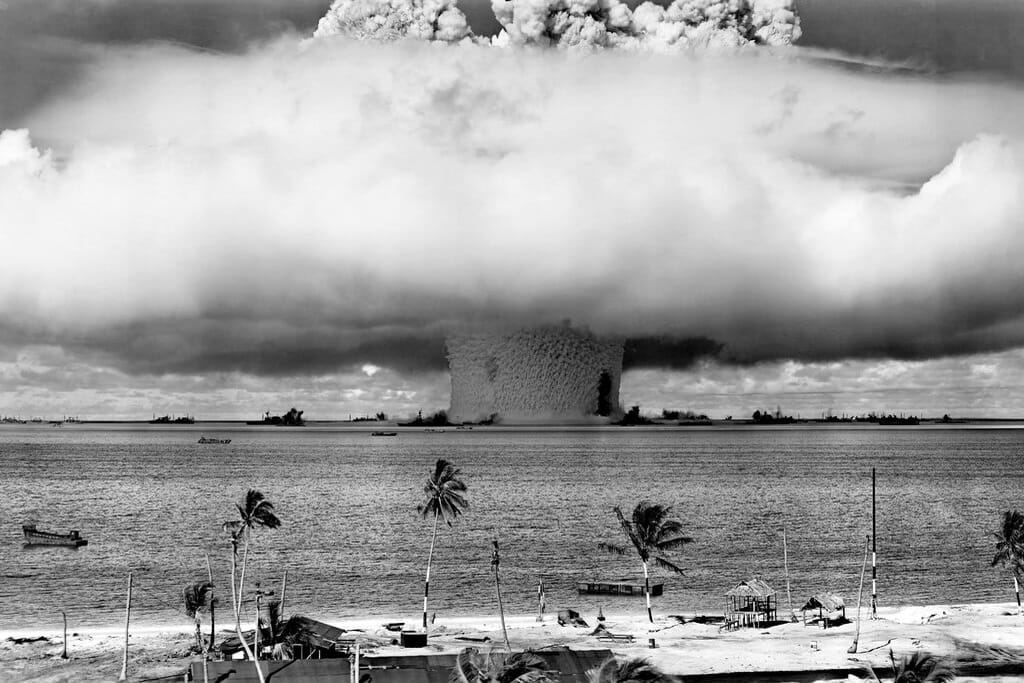
The image is of the first hydrogen bomb test, 01 November 1952, on the South Pacific atoll Enewetok
It might be said to picture the ultimate consequence of the “atomic theory,” which Richard Feynman thought would be the most valuable information to be passed on to whatever beings might survive after the end of human existence
But the “atomic theory” did not begin with 20th c. physics
The theory that “everything is composed of atoms” originated with some “natural philosophers” in Athens in the 5th c. BCE
Democritus [ca. 460-370BCE], along with Leucippus [also 5th c.], proposed that all things are compounds of atoms [from atomos = “uncuttable”] and pictured a “void” in which these small particles moved randomly and regularly “hooked” together to form every visible thing
It’s a remarkable vision, one of the many theories of the period aiming to account for our experience of a world and the phenomenon of change; these philosophers all began with a picture that people still share…
The picture we share of human experience is that things and events take place outside us, while emotions and thoughts occur inside ourselves
I think Feynman chose to convey the 20th c. interpretation of atomic theory because it most completely accounts for the composition of all elements of experience, including ourselves
But atomic theory leaves in place the picture of a world whose real elements are behind the things we see, including our own bodies
This is a mistake: there are not “levels of reality” or “hidden realms;” there is no “unchangeable” substance behind the changing process of appearances
It’s an ancient mistake, reflected in all languages: the error of picturing the duality of human consciousness as a structural fact
Human consciousness is dual in the sense that I can both do something and—at the same time—notice that I am doing it
This ability—called awareness or self-consciousness—is central to speech and allows us to learn and to teach; so it is of fundamental importance to human being
It also enables our knowledge of death: we very early—by the age of three or four— become aware that we have come into being and so correctly conclude that our being will come to an end; thus consciousness is the source both of the greatest of our powers and the most profound of our fears
The projection of conscious duality onto the experience of world constitutes the mistake I’m describing, but it also allowed us to imagine another world in which we do not die
It’s not by chance that visions of this other world beyond death are present in all human literature and language; the knowledge and fear of death are defining features of being human…
One conclusion from my line of argument is that there is no other world; a second conclusion: there are only appearances
This is the sentence I would leave behind…
"Appearing correct!" Very funny...
By all appearances, you are correct. Or at least you appear to be. ;)