Part II: What is..."power?"
Be like a child...

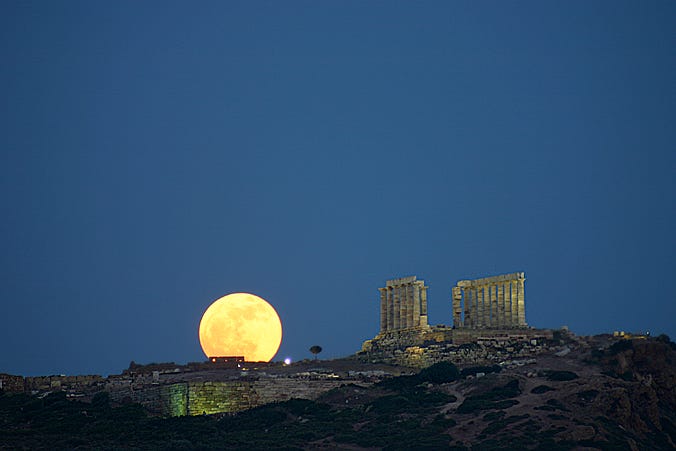
I took the photo years ago: the full moon is rising behind the “Temple of Poseidon” on the pennisula south of Sounion, some 60km S of Athens in Greece; I include it just because I like it!
But I digress: I was describing the scene one afternoon in 1962 when my small son was being threatened by the landlady of the property…
As she loomed above him I was about to intervene to defend him when I heard him say, “My daddy said I could dig here.”
Recall that I’ve pointed out, children are well aware of the power of adults; he knew she could hurt him…
But he nevertheless asserted his rights! He said—correctly—that he had my permission
My point is that he—like all of us all the time—demonstrated he had the power to refuse to do as he was ordered
I mean this: no one can be forced to act…
If you review your (no doubt immediate) objections, I suggest you’ll find they all invoke the “danger” of injury or punishment
Of course it’s true that you might be injured or even killed if you don’t comply with an order or demand…
But that’s all that can happen: you might be eliminated, but you cannot be made to do anything
So: why does anyone do anything because they’re ordered to do so?
Generally because they don’t want to suffer injury; we choose to cooperate to avoid consequences we dislike; we choose comfort or safety… I have two stories:
(1) Franz Jaegerstaetter was the only person in his Austrian town in 1937 to publicly refused to approve of Hitler; this was after Austria (Hitler’s birthplace) had been annexed to Nazi Germany. Jagerstaetter was arrested & jailed & subsequently hanged but he never agreed to say he approved of Hitler
(2) Primo Levi was an industrial chemist in Turin Italy; he was captured by invading Nazi forces in 1944 and imprisoned in Oswiecim Poland (in the murder camp built there by the Nazis & called “Auschwitz”); he survived to be liberated in January 1945 by advancing Soviet Russian troops; in the memoir he wrote (Si Questo e un Uomo = If This is a Man; published in English as Survival in Auschwitz) he describes three Polish inmates being publicly hanged because they had contrived to blow up one of the crematoriums built to incinerate the corpses of murdered inmates; Levi’s point is that these men were singled out for death; but the whole purpose of Nazi murder camps was to make death anonymous
I judge both stories to confirm my thesis: you can be murdered, but you can’t be made to act, any more than threats that day could force my tiny son to be afraid
I conclude that “power” always originates with each of us; it cannot be “seized” or
”imposed” or “taken away”I must agree to give up my power to decide how to act; power is only given; it cannot be taken
A final example: think about what happens on screen when a gun is drawn…
What follows is always talking! The person holding the gun gets to ask questions, give orders, etc. Why? Because the others in the scene give the person with the gun that power
Imagine a scene in which a gun was drawn & everyone ignored it! Primo Levi also recalls that he realized there were 100s of people being guarded by a single man with a gun
On one of the planes hijacked by terrorists in September 2001 the cabinfull of passengers were being threatened by a single man holding a boxcutter: several passengers ran forward & overpowered the terrorist, then attempted to do the same to the other criminals that had taken over the controls
The result of this struggle was that the aircraft—“Flight 93”—crashed in a field in Pennsylvania, instead of into an office building in some city like those that were flown into the “twin towers” in New York
Those resolute passengers illustrate my ultimate point: we are the only ones who can give up our power to act