How long should justice take?
A personal story...

Here’s a series of thoughts on my past I wrote a few months ago in the course of a long-running discussion with a fellow philosopher and friend:
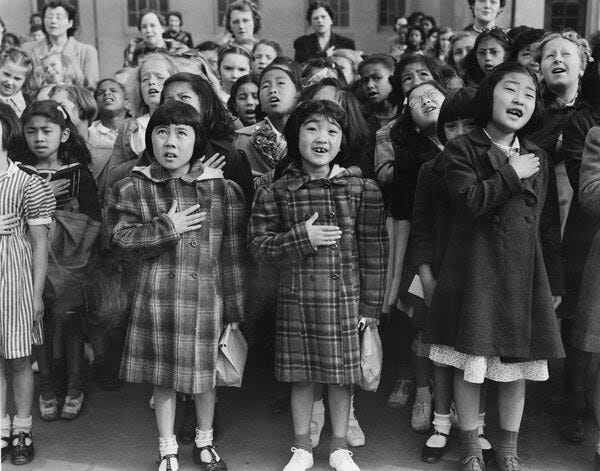
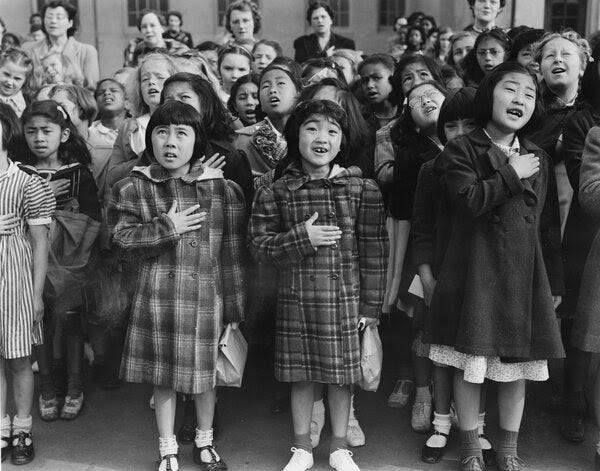
These 2nd graders, photographed by Dorothy Sayers in January 1942, are saying the “Pledge of Allegiance” at Weill Elementary (San Francisco CA). One month later they were imprisoned—along with their parents—at a concentration camp in the desert west of Bakersfield CA
I was in the 2nd grade in 1942 at Bandini Elementary in Los Angeles. Several of my friends disappeared from class that March. My parents wouldn’t answer my questions about them and it wasn’t until after the war in 1945 that I learned they had been victims of the U.S. policy to incarcerate Americans of Japanese ancestry
During the war my father was a machinist at Larsen Boat Works, initially converting the wooden-hulled boats of the San Pedro CA tuna fleet into minesweepers. I spent weekend afternoons at the shop, sweeping up wood shavings and carrying coffee to the workers. In one vivid memory I am looking closely at the war-advisory posters on the shop walls. One of them depicted overhead views of two human feet; the foot on the left features a prominent space between the first and second toes. The text informs me that “Japanese spies” can be detected by noting this space, caused by wearing thong sandals. I wondered, “How can you get people to take off their shoes?”
The point of these examples is both to illustrate the ways in which social policy can be constructed and enforced and to indicate how the young are schooled to accept the social order into which they are born
One more example: the barbershop I went to in San Pedro when in high school was on Gaffey Street; in the chair one afternoon I saw my friend Buster crossing the street toward the shop. “I need to tell my friend something,” I said to Gene, the barber. “How can you tell?” Gene said. “How can I tell what?” I said. “That you know him,” Gene said: “they all look alike to me.” This, too, is an example of training the young in the prejudices of their elders
The training did not take for me. Among several girlfriends through my teens I experienced the most criticism and resentment—from parents to acquaintances—when I was dating Pauline Lomeli. She was “Mexican,” in the cultural categories of Southern California during the 1950s, even though her family had been in California over the same five generations as mine.
I later married and raised my children in the U.S. culture as it unfolded in the 1960s, so their training was shaped by the anti-war movement and the emergent civil rights movement, the latter culminating in the 1964 Civil Rights Act
When still the U.S. Senate majority leader in 1960, Lyndon Johnson said, “If you can convince the lowest white man he’s better than the best colored man, he won’t notice you’re picking his pocket. In fact, if you can just give him someone to look down on, he’ll empty his pockets for you.” Johnson was right then, and his observation is accurate now too. Yet in 1964, as President, Johnson invoked “We shall overcome” in his speech celebrating passage of the 1964 act; I imagine he did this without irony.
In 1954 the Brown v Topeka decision of the U.S. Supreme Court, under Chief Justice Earl Warren, had found segregated schools to be unconstitutional; I was taking an Ethics course as an undergraduate philosophy major at Stanford in 1956 when Life magazine published William Faulkner’s “Letter to a Northern Editor;” I asked the professor, along with several of my fellow students, to add a discussion of this new civil rights issue; he refused, saying the matter was of “little significance.”
We held some discussions among ourselves anyway, though I was among the few who had not experienced the de facto school segregation created by patterns of housing sales and mortgage lending that characterized life in the “north.” Stanford itself had few undergraduate “minority” students. Still, we all agreed that the integration of schooling would lead inevitably to the integration of U.S. society.
That was the plan: schools in the south were to be integrated at the level of kindergarten and first grade; thus in 12years or so all children would have been educated to live as equals with all the people in their communities
Reading Faulkner’s “Letter” was therefore a shock. He forcefully objected to integration—and it’s implications for equality—by force of law.
If the law does not dictate—and enforce—the forms of equality defined by the 19th c. amendments to the constitution, how might those forms come about?
When Faulkner wrote in the 1950s, the southern states had resisted, and punished by force and homicide for nearly a century, not only the integration of the black population—former slaves and their descendants—but their access to housing, voting, and employment
Much of that black population responded by moving, beginning with the factory employment that grew rapidly with the introduction of assembly-line labor and the production-demands of WWI after 1915
Black citizens migrated to urban centers like Chicago, Detroit, and New York, leaving behind the stratified social system in the southern states
By the 1960s the distinction was being made between de jure inequality—the legal suppression of a target population—and the de facto forms that developed in the northern states to segregate the black population: by housing zoning and neighborhood policing
Even now such practices persist in the south and in the north
Nothing short of legislated and enforced standards and conditions can bring about the elimination of segregation and its attendant hierarchies
Where the standards had been buttressed by law—the de jure forms of discrimination in the south—two generations of legal intervention have altered much of the culture Faulkner wished to preserve

Edd’s Drive-In, for example, in Pasacagoula Mississippi—not far from Faulkner’s Oxford home—has been in business at the same location since the 1940s
This recent photo shows black staff and customers being served; at the right of the frame is a small window with a counter that seems to have no function
The proprietors chose to keep the now-unused window after the end of segregation: it originally segregated black customers not permitted service at the front
I don’t know whether many of Edd’s customers are aware of this historical memento; in any case, people learn the practices they find around them as they grow
If those practices are maintained, by force or by indifference, they will not change…
I conclude that justice cannot wait upon some sort of evolution in the minds of the very people whose status and power depend upon the forms they—and their ancestors—have forged to maintain a status quo…