"Ethics" & "morality:" Part Two
On culture and history...

Let us begin with some humor…
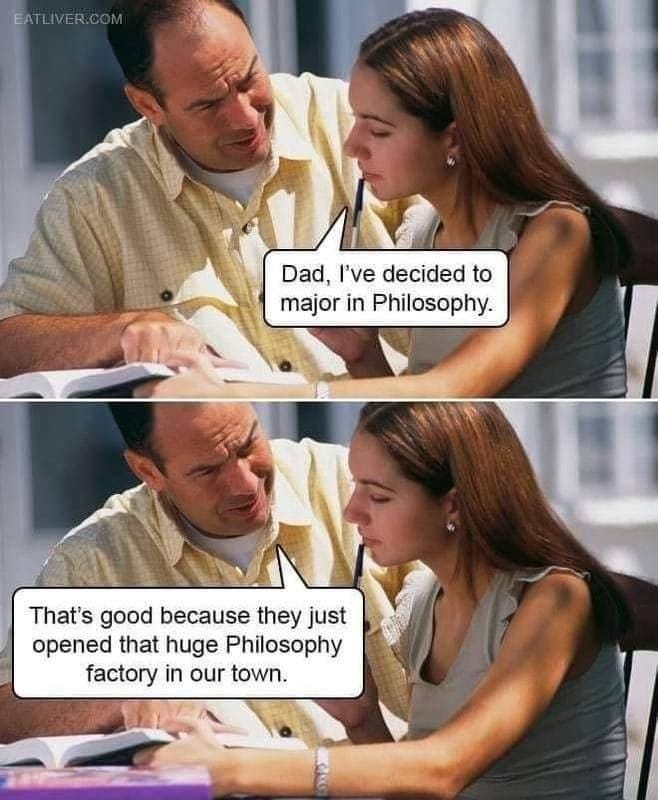
At least part of the joke in these panels depends on assuming that the point of education is to get a job
That’s not the point of education—or philosophy—of course; I’ll return to this topic…
But a more relevant point for the discussion of morality and ethics is that humans have no natural form of life
That is, as I pointed out earlier, our lives—unlike other animals—are not shaped primarily by instinct; humans have to devise ways of living; the 20th c. philosopher Ludwig Wittgenstein claimed that “every language is a form of life”
Wittgenstein’s insight is that we articulate and enshrine social practices in our ways of speaking; indeed ordinary words and phrases hold whole “worlds” of human experience
These “worlds” tend to persist, because—like people generally—language is “conservative:” it tends to perpetuate forms of speech; we just adapt them to changed uses
We still speak, for example, of “sunrise” and “sunset,” even though no one is any longer under the misapprehension that the sun orbits the earth
But it’s not just linguistic “conservation” at work: people deliberately work to preserve the practices they themselves learned
We do this by designating social customs as “traditions,” “ideals,” “values, “absolutes,” and so on: an array of terms aimed at concealing the fact that all forms of life are historical
In other words, practices change; they do so whenever enough people in the next generation fail or refuse to adopt the practices of their parents
In the humor-panel above, for example, the daughter’s choice threatens the parent’s view of life
There’s no more common thread in the talk of people in or near my age group—I’m 85—than complaints about the conduct of “young people”
The subtext of these complaints is the intuitive awareness of the fact I started with: our ways of life are customary, not “natural” or instinctive, and since they are created they may also be changed
First conclusion, then: there are no “absolute” or unchanging “values” or practices; human culture regularly evolves new forms
Of course, these forms will have their own history: the young will eventually reform or abandon them in favor of others; indeed, they are doing so now…
Second conclusion: resenting or attempting to repress the cultural change that is always at work is reactionary
Most destructive and even vile acts perpetrated socially—and even legally—are justified on the grounds of “preserving values”
They are always wrong; not morally wrong but historically so: they violate the very process of human life…