Do "Past" & "Future" exist?
The short answer is "no"...


What is observable from Earth is that the “paths” of galaxies (light sources) within the “observable universe” show that “sources of light” are visible in all direction
It follows from this that the origin of what there is—the ‘Big Bang’—was a rapid expansion, not an “explosion;” in other words, the universe has no point of origin but has always been expanding in all directions (as well as accelerating, as we now know)
Another way to put this point is that, while there are distances between all masses there are no directions: that is, there is no “past” somehow “behind” where we are now
My larger point is that the “temporal” quality with which we experience time is not a property of being
What we think of as “past” is memory and what we call “future” is imagination
The popular notion that one could “go back into the past” is false: lots of what existed in the past still exists of course, but it exists just where it was then
One of the things I like to point out, for example, when I’m in Rome with others, is that ancient Rome still exists: it’s right there in the middle of the old city, just about 14ft below present street level (see photo above)
14ft, incidentally, is about the amount of dirt that has fallen onto that spot of earth over the course of 2000+ years)
A footnote on that last point: “dirt” accumulates on the earth from the atmosphere in which countless meteorites disintegrate daily and falling onto the ground as “dust;” one convincing illustration of this process is that dust falls on shipboard even 1000s of miles away from land
(On U.S. naval ships, crew members are assigned to “dusting duty” even in the middle of the Atlantic or Pacific oceans…)
But I digress: the ancient Roman forum is both past and still present
It shares this character with everything else that existed in the past (most of it buried, as the old city of Rome was before being excavated)
When humans now come upon these buried features we excavate the dirt over them to uncover them; so there is no place “in the past” for earlier things to be
Similarly, what we call “the future” is only what we imagine things will become, not some “location” already existing, to which we might somehow “go”
Herbert George (“H.G.”) Wells [1866-1946] was therefore wrong when he wrote The Time Machine [1895] in which he describes a device which can “fly” its occupant “forward & backward in time…”
…because there are no “places” called past and future
There is exclusively only the present in which we all live and on which we depend for our continued existence
Related to this mistake about “past” and “future” is imagining a habitable place other than the earth on which humans might live (if only travel to such a place were possible)
However this mistake differs; some “earth-like” planets may exist, but humans have evolved in the thin layer of atmosphere & from the biological processes that exist upon earth
Some planets may be “earth-like,” even to the extent of occupying similar solar orbits, possessing similar surface properties, etc.
But such places would still have to be modified to imitate conditions on earth; building “habitats,” inside of which earth-conditions can be simulated, is of course an example of “imitating earth”
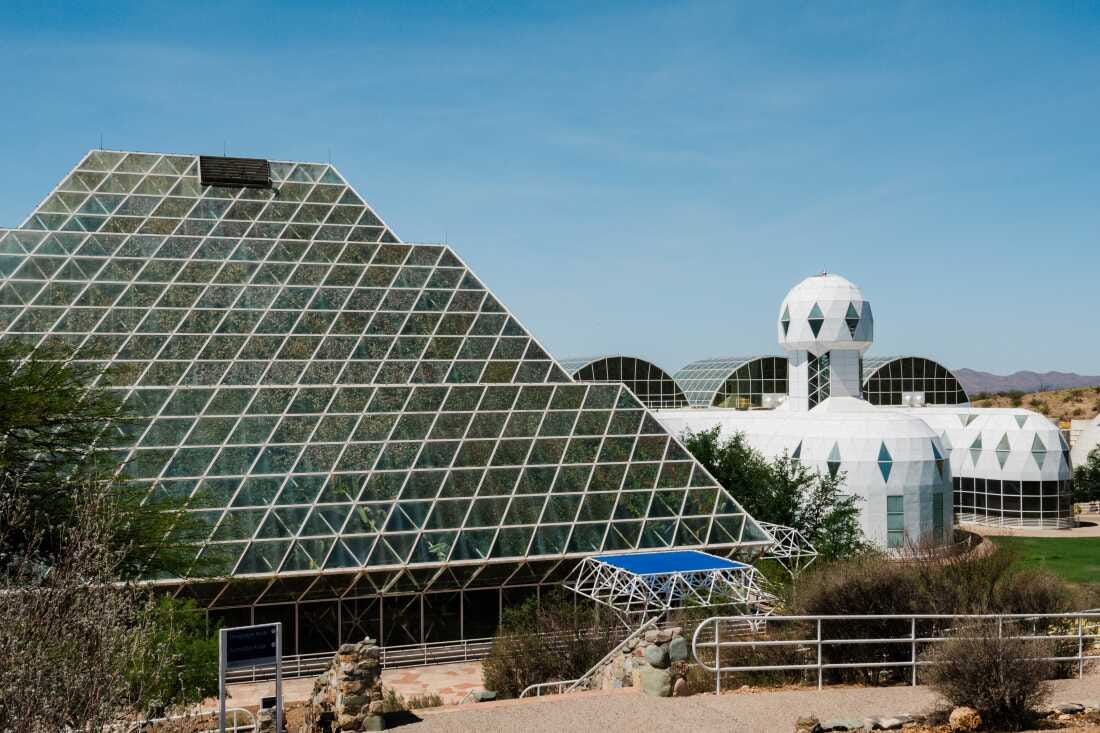
In 1986 the “Biosphere” project was completed (just west of Oracle AZ) to attempt precisely this project: construct a self-contained and self-sustaining closed environment in which people might live indefinitely…
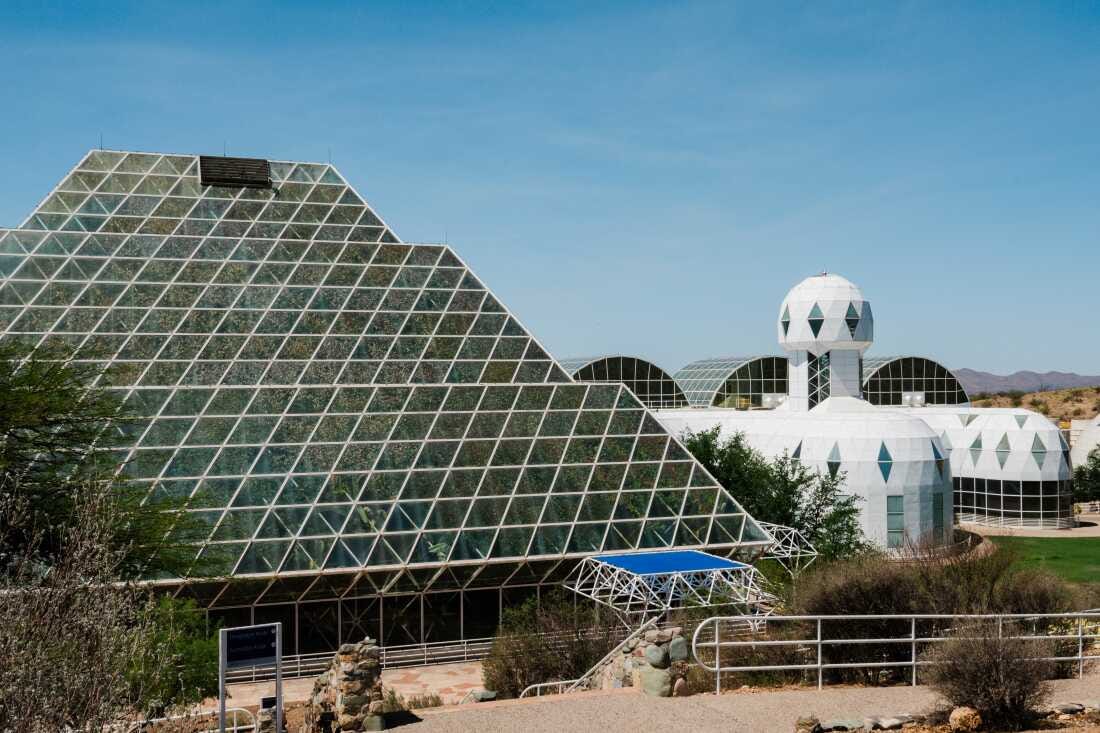
by growing their own food, recirculating and treating their own waste, waste water, and so on…
In short, the builders attempted to construct an “earth-colony” of the sort that might be built on another planet…
Biosphere was occupied by the first crew—4 women & 4 men—from 1991-1993; they were selected for their compatibility as well as their skills at engineering, electrical, and other functional abilities
Yet life for the crew proved to be unsustainable, despite the investment of $200 million for construction & extraordinary attention to providing what was thought to be the necessary kinds of plants & animals
The plants grew (they now form dense jungles) & the animals propagated, but the people could not live: what they learned was that the soil microbes essential to sustaining plant life excreted CO₂ at a rate that exceeded the plants ability to produce oxygen
So the built-environment could not sustain human life though most of the other forms of life were able to thrive
What this proves is that duplicating earth conditions artificially, as would have to be done on an extra-earth world, is not yet possible
(Even if this obstacle could be overcome, there is the fact that the “Biosphere” required millions of tons of metal, glass, and other materials that exist only on earth and would also have to be transported)
Thus the mistake made by proposing to move humans to another world has to do with our own dependence upon just the conditions that exist only on earth
The inevitable conclusion is that humans cannot move and so must cease damaging the only environment in which we are able to live…